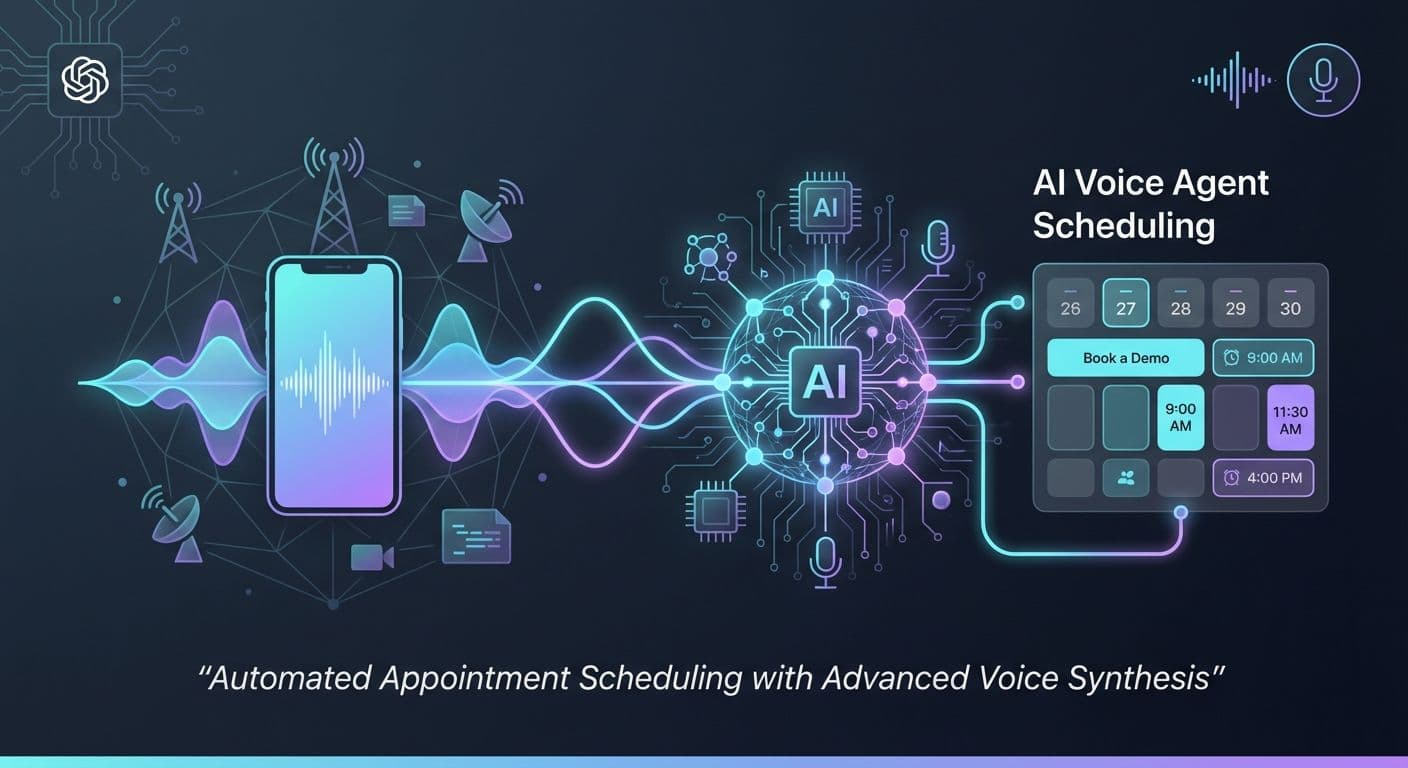
Voice AI is transforming how businesses handle phone communications. Instead of putting customers on hold or limiting availability to business hours, companies can now deploy intelligent voice agents that understand natural language, respond with human-like speech, and complete real tasks like scheduling appointments.
This guide walks through building a production-ready AI voice agent for appointment scheduling using three powerful technologies: OpenAI for intelligence, ElevenLabs for natural voice synthesis, and Twilio for telephony infrastructure.
Building a voice agent requires three core capabilities: understanding what callers say, generating intelligent responses, and speaking those responses naturally. Each component in our stack handles one of these responsibilities.
OpenAI's GPT-4 serves as the brain of the operation. It processes transcribed speech, understands intent, maintains conversation context, and generates appropriate responses. The model can handle complex scheduling logic, check availability, and manage edge cases like rescheduling or cancellations.
ElevenLabs provides voice synthesis that sounds remarkably human. Unlike robotic text-to-speech systems, ElevenLabs generates natural intonation, appropriate pacing, and emotional nuance that makes callers comfortable during the conversation. You can even clone specific voices to match your brand.
Twilio handles the telephony infrastructure: receiving inbound calls, making outbound calls, streaming audio in real-time, and sending SMS confirmations. Their programmable voice API integrates seamlessly with our AI components.
The system operates as a real-time pipeline. When a call comes in, Twilio streams the caller's audio to our server. We transcribe the speech using Whisper or Twilio's built-in transcription. The text goes to GPT-4 along with conversation history and scheduling context. GPT-4 generates a response, which ElevenLabs converts to audio. Finally, we stream that audio back through Twilio to the caller.
This entire loop needs to happen quickly enough that the conversation feels natural. Latency is critical in voice applications. Callers notice delays of more than a second or two, which breaks the conversational flow. We optimize by streaming audio rather than waiting for complete utterances, using websockets for real-time communication, and caching common responses.
The quality of your voice agent depends heavily on prompt engineering and conversation design. The system prompt establishes the agent's persona, knowledge boundaries, and behavioral guidelines. For appointment scheduling, this includes available appointment types, business hours, required information to collect, and escalation paths for situations the AI cannot handle.
Design conversations to be efficient but friendly. The agent should greet callers warmly, quickly understand their intent, collect necessary information without feeling like an interrogation, confirm details, and end the call professionally. Include appropriate acknowledgments and transitions to maintain natural flow.
Handle edge cases gracefully. Callers may speak multiple languages, have thick accents, talk over the agent, or ask questions outside the scheduling domain. The agent needs strategies for each situation: language detection and switching, asking for clarification when unsure, waiting for the caller to finish speaking, and politely redirecting off-topic conversations.
The voice agent needs access to real-time calendar availability to schedule appointments. We implement this through function calling, where GPT-4 can query available slots, book appointments, and modify existing bookings. The functions connect to your calendar system, whether that's Google Calendar, Microsoft 365, or a custom practice management system.
When a caller requests an appointment, the agent checks availability for their preferred time. If unavailable, it suggests alternatives. Once a slot is selected, the agent collects required information like name, phone number, and reason for visit, then books the appointment and sends an SMS confirmation through Twilio.
Natural conversations include interruptions, corrections, and changes of direction. Callers might interrupt the agent mid-sentence to provide information or correct a misunderstanding. Your system needs to detect these interruptions, stop the current audio stream, and respond to the new input.
Implement barge-in detection by monitoring for voice activity while the agent is speaking. When detected, stop the TTS stream and process the new input. Maintain conversation state carefully so the agent understands the context of corrections like "No, I said Tuesday, not Thursday" or "Actually, make that 3 PM instead."
Not every call can be handled by AI. Build robust escalation paths for situations that require human intervention: medical emergencies, upset callers, complex insurance questions, or technical issues. The agent should recognize these situations and transfer smoothly to a human operator when available, or take a message for callback.
Implement fallback behaviors for technical failures. If transcription fails, ask the caller to repeat. If GPT-4 returns an error, use a pre-scripted fallback response. If the call quality is too poor, offer to call back or text instead. Never leave callers in silence wondering what happened.
Log all calls with transcripts, AI responses, and outcomes. This data is invaluable for improving the system. Review calls where the agent struggled, identify common questions not handled well, and refine prompts accordingly. Track metrics like successful booking rate, average call duration, and escalation rate.
Consider implementing a feedback mechanism where callers can rate their experience. Low ratings trigger review of the call transcript, helping you identify and fix issues quickly.
Voice AI has multiple cost components: Twilio charges for call minutes, OpenAI charges for tokens, and ElevenLabs charges for characters synthesized. A typical 3-minute scheduling call might cost between $0.15-0.30 in API fees. Compare this to the cost of human staff time for the same call.
Optimize costs by caching common responses, using shorter system prompts, and implementing efficient conversation flows that minimize back-and-forth. Consider using GPT-3.5-turbo for simpler parts of the conversation and reserving GPT-4 for complex reasoning.
Building production-quality voice agents requires careful attention to latency, conversation design, and error handling. The technology stack of OpenAI, ElevenLabs, and Twilio provides all the building blocks, but the magic happens in how you integrate them and design the user experience.
Start with a narrow use case like appointment scheduling where the conversation flow is relatively predictable. Get that working smoothly before expanding to more complex scenarios. Focus on making the experience feel natural and helpful rather than trying to make the AI sound impressive.
Voice AI is still early but maturing rapidly. The combination of large language models and realistic voice synthesis has crossed the threshold where callers often cannot tell they are talking to an AI. For businesses handling high call volumes with repetitive inquiries, voice agents offer a compelling solution that improves customer experience while reducing costs.