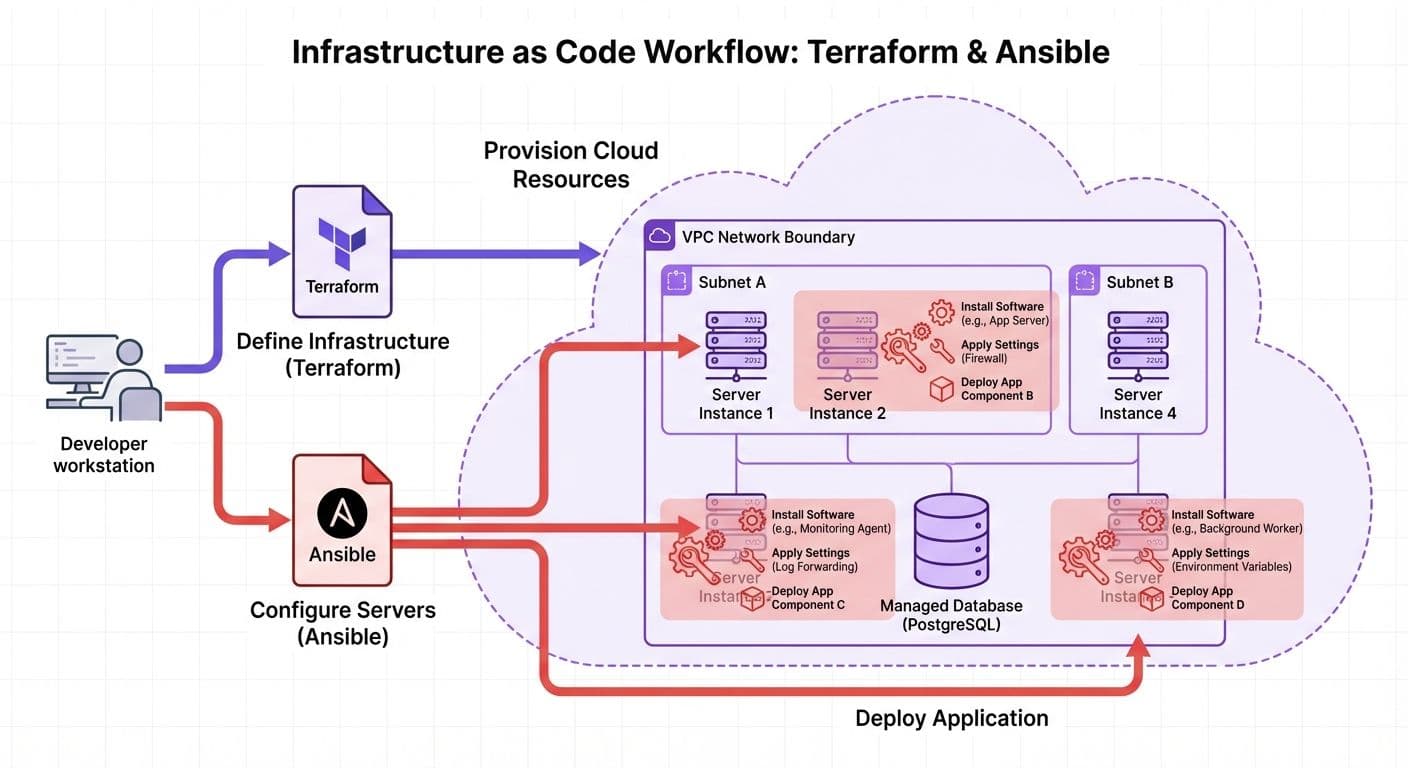
Diagram showing Terraform provisioning cloud infrastructure and Ansible configuring servers
Back to Blog

Infrastructure as Code with Terraform and Ansible

Learn how Infrastructure as Code with Terraform and Ansible enables reproducible, automated, and scalable cloud infrastructure management by separating provisioning from configuration.

QT
QuantaCodes Team
Author
3 min read

Infrastructure as Code with Terraform and Ansible

Infrastructure as Code (IaC) has transformed how teams manage and provision cloud resources. By treating infrastructure configuration as software, organizations gain reproducibility, version control, and automation capabilities that manual processes simply cannot match.

The Case for Infrastructure as Code

Traditional infrastructure management through manual configuration is:

  • Error-prone: Human mistakes are inevitable at scale
  • Slow: Manual provisioning creates bottlenecks
  • Inconsistent: Environments drift over time
  • Undocumented: Knowledge lives in people's heads

IaC addresses all these challenges by codifying your infrastructure in declarative configuration files.

Terraform: Infrastructure Provisioning

Terraform, developed by HashiCorp, excels at provisioning and managing cloud resources across multiple providers.

Key Concepts

  • Providers: Terraform plugins that interact with cloud platforms (AWS, GCP, Azure) and services.
  • Resources: The infrastructure components you want to create (EC2 instances, S3 buckets, VPCs).
  • State: Terraform tracks the current state of your infrastructure to determine what changes need to be applied.
  • Modules: Reusable packages of Terraform configuration for common patterns.

Best Practices

  1. Use remote state: Store Terraform state in S3 or similar backends for team collaboration.
  2. Implement state locking: Prevent concurrent modifications with DynamoDB or similar.
  3. Organize with modules: Create reusable modules for common infrastructure patterns.
  4. Use workspaces: Manage multiple environments (dev, staging, prod) with workspaces.
  5. Pin provider versions: Ensure reproducible builds by locking provider versions.

Ansible: Configuration Management

While Terraform provisions infrastructure, Ansible excels at configuring the software and services running on that infrastructure.

Why Ansible?

  • Agentless: Uses SSH, no agent installation required.
  • Simple syntax: YAML-based playbooks are easy to read and write.
  • Idempotent: Running playbooks multiple times produces the same result.
  • Extensive modules: Thousands of modules for common tasks.

Ansible Playbook Structure

Playbooks define the desired state of your systems through:

  • Inventory: Lists of hosts and groups to manage.
  • Roles: Reusable units of configuration.
  • Tasks: Individual configuration steps.
  • Handlers: Actions triggered by task changes.
  • Variables: Parameterized configuration values.

Combining Terraform and Ansible

The most powerful IaC implementations combine both tools:

  1. Terraform provisions the base infrastructure (VPCs, instances, databases).
  2. Ansible configures the software stack (packages, services, applications).

This separation of concerns keeps each tool focused on what it does best.

Integration Patterns

  • Use Terraform's local-exec provisioner to trigger Ansible after resource creation.
  • Generate Ansible inventory dynamically from Terraform outputs.
  • Use Terraform to create AMIs with Packer, pre-configured with Ansible.

Getting Started

Ready to adopt IaC? Start small:

  1. Pick one environment or project as a pilot.
  2. Document your current infrastructure manually.
  3. Translate that documentation into Terraform configurations.
  4. Add Ansible playbooks for configuration management.
  5. Iterate and expand coverage gradually.

Conclusion

Infrastructure as Code with Terraform and Ansible brings software engineering practices to infrastructure management. The investment in learning these tools pays dividends in reliability, speed, and team productivity.

Need help implementing IaC in your organization? QuantaCodes specializes in infrastructure automation and can guide your team through the transformation.